Most would have you think it is complicated to measure face proportions in the comfort of your own home but it is not. There is no requirement for a clinic or some contraption with a ring light that has you looking as though you are residing in a refrigerator. By calculating the calculating face golden ratio, a matter of patience, the proper facial landmarks, a straight-on arrangement and some rudimentary tools will do.
I am Thomas Murphy and I will be as practical about it as can be. In this guide I put forward a way of doing your face measurements at home, from the width and length to the vertical thirds, and show how one might go about the golden ratio without it becoming a maths lesson.
The Case For Measuring
One can make a case for it. Perhaps before you take up a new beard style, change your glasses or have a haircut you want to get a handle on your face shape. It applies to portrait work in drawing and photography too, as well as where to put your makeup or plan a skincare regimen.
But then there is no point in pursuing perfection. What is of use is to be familiar with your numbers so as to see the oddity in a face’s symmetry or the patterns of proportion, and why something in a photograph does not accord with what the mirror shows. That is of more consequence than trying to live up to someone else’s notion of an ideal.
For Whom This Is
If you are after an unvarnished at home guide rather than cosmetic theatre, you will find this method to your liking. Handy for when you are sizing up a hairstyle, thinking of a grooming alteration, or to put to the test whether an app is being economical with the truth.
It is not for those in need of a surgical or medical opinion. You can measure proportions at home but do not mistake it for a clinician who can evaluate bone structure or asymmetry and plan treatment.
What You Will Need
Hassle is avoided with the right equipment. Do not go changing from a stretched tape to a mirror to a selfie you took in the pub car park. Be organised and do it the same way every time; your results will be better for it than if you were to guess at half the landmarks with a host of gadgets.
- A soft tape (cm and inches)
- Ruler of a size for short work such as eye spacing
- Mirror, well lit
- Front facing shot or one on a tripod
- Phone grid to align with
- Something to put down your figures, be it a notes app or pen and paper
Getting Set Up
Shoulders down and upright, look ahead. Daylight is best, or from the front at least. An overhead source will put shadows under your nose and brow and you will lose your landmarks.
Hair should be off the forehead if you are measuring to the hairline. Make a note of it if the line is receding or uneven. For a man of a certain age the natural hairline is enough to have a tiff with the mirror.
Accuracy First
Put the face at rest before you put the tape to it. None of that jutting out your chin like you are in a cologne commercial, or a smile and arched brows. The movement of muscle will alter what you see. I learned early on by my own proportions not to measure once in the mirror and again from a photo taken from above. The numbers were all over the place, a different story altogether for the same face.
Positioning For A Photo
An arm and a half distance will keep the lens from making the centre of the face seem larger than life. Head flat, camera at the level of your eyes. More of a passport photo than anything for a dating site.
The Australian Government’s rules for a passport photo are a good rule of thumb for the home measurer. They call for the face to be square to the camera and a “neutral expression”, which goes a long way to avoiding distortion in a front facing picture. Check the requirements of the Australian Passport Office passport photo requirements.
Identifying Your Landmarks
Proper calculation is out of the question if you are left to wonder where one point ends and another starts. Even with features that are not sharply drawn you must be able to pick out the same landmarks each time. Most of the face measurements one would do at home are predicated on a few key landmarks: the hairline and brow, the inner and outer corners of the eyes, the jaw corners, the widest part of the forehead and cheekbone, the chin and the base of the nose.
Key Points To Mark
One will find the brow line running along the bony ridge or the top of the eyebrows themselves. The upper lip and the base of the nose meet where the nostrils terminate. As for the chin, the point to be made is the lowest central one, not the softness beneath it.
To get the cheekbone width you need to go across the zygomatic area to its widest. When it comes to the jawline, measure from the mandibular angles out; should the corners elude you, put your fingers to the angle change under the ear line.
Vertical Lengths
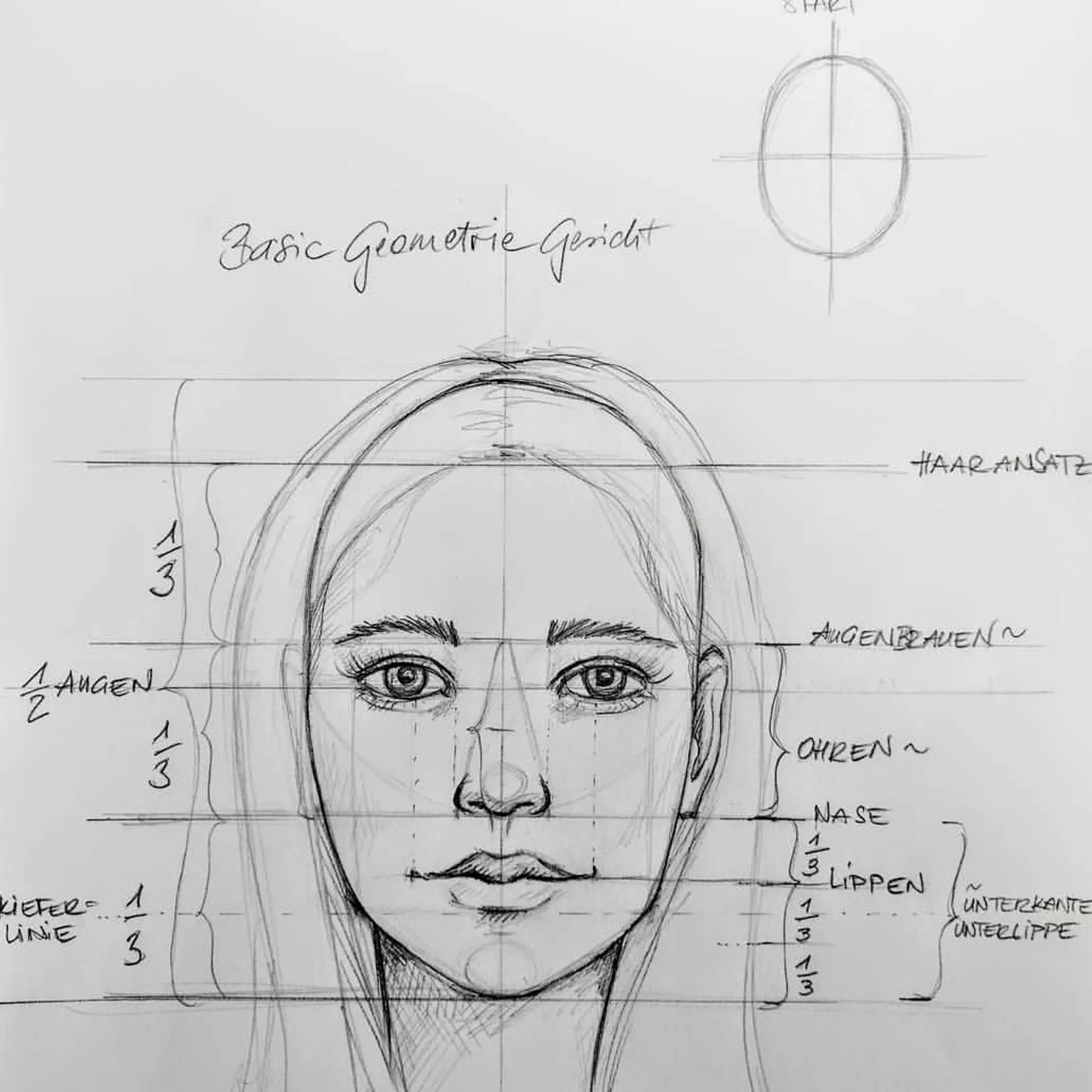
Here you can determine the length of the face and the vertical thirds pattern. In theory the face is made up of three even sections from hairline to brow, brow to the base of the nose and thence to the chin. But do not be concerned if yours are not so equal, there are many an attractive and unremarkable face that defies the textbook. It is a guide, not a licence check.
Upper And Lower Segments
Record these four distances in cm or inches, but be consistent with the unit when you come to compare them. They are to be measured in a straight line down the centre of the face.
- Hairline to brow
- Brow to base of nose
- Base of nose to chin
- The total from hairline to chin
Should the hairline be indistinct, make use of the upper forehead midpoint as an alternative reference and put both sets of figures side by side rather than take one dubious point as gospel.
The 1:3 Face Rule
There is much inquiry into this rule. Put simply it is an assessment of the three vertical parts of the face being of like length, though not necessarily the same to a mathematical degree. Reality has a way of differing from expectation in a home measurement; an unevenness is to be expected. A higher hairline may yield a shorter upper third or the lower third will run longer. Nothing wrong with the face for that, it is only human.
Horizontal Distances
These will give more of an indication of face shape than is generally thought. A cheekbone width that is in excess of the jaw and forehead might point to an oval or diamond. A wider jaw could mean a square or triangular countenance.
It is also where you will want to put the intercanthal distance and eye spacing to use. Under the flat light of a phone camera a small variance can affect the balance of a photo.
Width Across Key Areas
Hold the tape level for these, do not let it curve over the face as that will put extra length on the result and fool you.
| Measurement | How To Measure | What It Helps Show |
| Forehead Width | Midway between brows and hairline at the widest | Upper face breadth |
| Cheekbone Width | Widest points of the cheekbones | Overall face width |
| Jaw Width | Angle to angle on the jaw | Structure of the lower face |
| Face Length | Centre line from hairline to chin | Proportion of the face |
| Intercanthal Distance | Inner eye corners | Reference for eye spacing |
| Eye Width | Inner to outer corner of a single eye | For classic spacing |
Eye Spacing
By some portrait convention the space between the eyes is the same as the width of one. It is no hard and fast rule but a proportion guideline of sorts, yet it has its uses in working out the proportions of a face in a picture. Compare the intercanthal distance with the width of an eye; if they are alike you are in keeping with the classic reference. If not, then your spacing is just a bit wider or narrower.
Ratios
The raw numbers will tell you something but ratios put things in perspective. They allow for a comparison of features without the distraction of whether the face measures 18 or 20 cm. Proportion is what counts, not the size of it. A well balanced face can be any length or breadth so long as the ratios are right.
The first thing to put down is the face height to width ratio, which is a matter of dividing the total length of the face by the cheekbone width. Take a face 19.0 cm long and a cheekbone 14.0 cm across and you have a 1.36 ratio. The higher the figure the longer the face, lower and it is broader.
One can make comparisons between the vertical thirds or set the intercanthal distance up against an eye width. For those who want to follow the golden ratio face method, feature relationships are put to the Phi ratio of 1.618 or so, be it forehead to nose or face length to width; what one site will do another will not.
Golden Ratio Usefully Explained
You will come across the Golden Ratio in any discussion on beauty, with a degree of sureness that is hard to justify. Put simply, Phi is a mathematical ratio at about 1.618 and certain theories of beauty would have it that features in closer conformity with that are more harmonious.
Do not expect to find an official test for a golden ratio face in general use. You could put the same photo into Omni Calculator or Golden-Face-Ratio.com and get a different result from each because they employ their own landmarks and formulas. In the end, manual measurements are worth more than some showy score.
Photos And Calculators
There is convenience in a photo: no tape to slip and you can zoom in to put a line where you like and recheck your points. But distortion is quick to set in too. A phone selfie taken at close range has a way of throwing off the ratios by making the nose and centre of the face appear wider.
An online proportion tool should be regarded as a second opinion, not the word of God. Thomas Murphy has a straightforward rule: if a calculator cannot discern a tilt of the head, it has no business pronouncing on your bone structure.
Cross-Checking
A front-on picture at eye level is the way to go. Put it in an editing app that has a grid and mark off the hairline, brow, chin, base of the nose, the corners of the eyes and jaw, and the edges of the cheekbones. See how those figures stack up to your notes. Should they be at odds, there is likely some distortion or a change in position; put down the camera and re-shoot rather than think your face has changed in the night.
Interpreting The Numbers
Folk have a habit of rushing this and then getting it wrong. The numbers are descriptive of the structure, nothing more. There is no verdict to be had. An asymmetry here and there, a broad jawline or a protracted lower third are all part of everyday life and go unnoticed. Measuring at home is for finding patterns to inform your styling, not to see if you live up to some notion of an ideal.
Shape Patterns
Where the face is longer than the cheekbone width and the jaw gives way softly to the cheeks, an oval is in evidence. Similar dimensions in length and width and the face will seem rounder. A square shape is more probable when the jaw and forehead are broad and angular. A diamond is in play if the cheekbones are the widest point and the rest tapers; a heart or inverted triangle if the forehead has more width than the jaw. A calculator can put order to it but let the raw numbers be your guide.
What Is Done Wrong
Not the mathematics, but the approach is where most of the trouble is. People will measure over a smile, wrap the tape to the curve of the face, make an educated guess at the cheekbone, or hold up a mirror measurement to a warped selfie and be surprised at the discrepancy. I have put in the work on half of these, for the most part before my morning coffee. Nonsense with a few decimals to its name is what I got, not any kind of insight.
Accuracy Fixes That Matter
Be consistent in your posture, the lighting and the mirror you use. Take three measurements and average them out; should one be way off, discard it. You will find consistency trumps enthusiasm on any given day.
On the subject of timing, allow 20 or 30 minutes for a first session in full, photo included. After you have the landmarks down, 10 minutes is all a recheck requires. Make sure your face is at rest to do it, not when you are puffed up from a salty takeaway (like a road train tyre in the heat) or some shaving irritation post-workout.
Quick Reference Guide
Ten spare minutes before work, or a day at best? Then make total face length, cheekbone and jaw width, and eye spacing your priority. The four of them will tell you more about your face shape and what to do with it styling-wise than anything else.
For the beginner there is no point in trying to get clever with Phi scoring right out of the gate. Stick to proportion checks and solid landmarks. A fancy formula does not forgive crooked base numbers.
Simple Home Benchmark
Expect your face length to be in excess of the cheekbone width as a rule of thumb, and while the vertical thirds will be close they are rarely equal. One cannot say a 20 cm face is large or small without a width to compare it to, and context in the way of age, sex and proportion. The same goes for the celebrity comparisons one might read in a Birchbox piece or from Dr. Schmid and others making commentary online. They are of interest but hardly a universal standard. Put your own data to use.
Frequently Asked Questions
How Do I Measure My Face Proportions?
From good facial landmarks, measure the total length of the face as well as the width of the forehead, cheeks and jaw and the space between the eyes. You can then look at ratios like height to width and the relationship of the vertical thirds.
Is A 20 Cm Face Small?
In and of itself, no. Without a base to relate to, particularly the width, the figure is of little consequence. Depending on the proportions of the cheekbones and elsewhere a 20 cm face could be long or balanced or just average.
What Is The 1:3 Face Rule?
A matter of dividing the face into three vertically, from hairline to brow, brow to the nose’s base, and thence to the chin. They are compared for balance though perfect equality is not required.
How Do I Measure My Jawline To Determine My Face Shape?
Go straight across the widest part of the jaw, the angles under the ears for instance. In relation to the forehead and cheekbones and overall face length that will give an indication of your shape.
Can I Use An App Instead Of Measuring Manually?
You can, but I would use an app to cross-check. The manual way is to be trusted over an app which can be led astray by lens distortion or how the camera is placed.
Final Takeaway
Do it the way that works if you are measuring at home: keep it unexciting with a neutral expression and a head on photo, level measurements and simple ratios.
The value is in being able to make better decisions on everything from your hair and glasses to the way you are photographed, not in neatly ticking the boxes on a website or some golden ratio theory. Write the numbers down and put some thought into it, do not let a poor quality selfie have the last word.
